
How Geopolitical Tensions Are Driving Crypto Volatility in the New Age of Financial Warfare
Table of Contents
ToggleIntroduction
In the early hours of a Tuesday morning in October 2023, as news broke of missile strikes near the Strait of Hormuz, cryptocurrency traders around the world watched their screens with a mixture of dread and calculated anticipation. Within ninety minutes, Bitcoin had swung nearly eight per cent, first plummeting as risk appetite evaporated, then sharply recovering as investors reconsidered its role as a geopolitical hedge. It was a microcosm of something far larger: the deeply entangled relationship between war, oil, and digital assets that now defines the modern financial landscape.
Cryptocurrency was once dismissed as a fringe technology, the plaything of idealistic libertarians and tech-savvy speculators with little connection to the “real” world of geopolitics, energy markets, and sovereign power. That dismissal is no longer credible. As the global order fragments, with active conflicts reshaping supply chains, sanctions redrawing the map of permissible trade, and great-power competition accelerating the search for dollar alternatives, Bitcoin and the broader crypto ecosystem have become embedded in the sinews of international finance.
The relationship is neither simple nor one-directional. Geopolitical shocks generate volatility, but they also generate opportunity. Sanctions push entire economies toward blockchain rails. Energy disruptions ripple through the proof-of-work mining industry. Central bank responses to war-driven inflation alternately punish and reward speculative assets. And beneath all of it, a deeper structural shift is underway: the gradual erosion of dollar hegemony and the frantic, often chaotic search for what comes next.
This article examines eight dimensions of the war-oil-Bitcoin nexus, tracing the mechanisms by which geopolitical tension translates into crypto volatility, and asking a harder question: is that volatility merely noise, or is it the sound of a new financial architecture being born under fire?
The Shock Transmission Mechanism: How Wars Move Markets
To understand why geopolitical crises move crypto markets, one must first understand how they move all markets. The classic transmission mechanism runs through three channels: risk sentiment, commodity prices, and monetary policy expectations. When a military conflict erupts or escalates, investors globally reprice risk. Equities fall, safe-haven assets surge, and volatility indices spike. Oil and natural gas prices jump as supply disruption fears take hold. Central banks, caught between inflationary energy shocks and recessionary demand pressures, face impossible policy choices.
Cryptocurrency sits awkwardly across all three channels. As a speculative, high-beta asset, Bitcoin typically sells off sharply in the first hours of a geopolitical shock, behaving like a tech stock rather than a store of value. The initial response to Russia’s invasion of Ukraine in February 2022 was instructive: Bitcoin dropped roughly twelve per cent in the first forty-eight hours. Yet within weeks, it had recovered and, in some analyses, was showing a negative correlation with the rouble while Ukrainian and Russian civilians were actively using stablecoins to move wealth across borders.

This bifurcated behaviour, sell first, reconsider later, has become a fingerprint of crypto’s geopolitical response. Liquidity-hungry traders unwind positions in the initial panic; longer-term holders and institutional desks then reassess whether the conflict actually strengthens Bitcoin’s structural narrative. The speed and depth of the first leg depend on leverage ratios in the crypto derivatives market, which have grown enormously as institutional participation deepened throughout the 2020s.
What makes the transmission mechanism particularly volatile is that crypto markets operate continuously, without circuit breakers or exchange closures. While the New York Stock Exchange can halt trading and central banks can intervene with liquidity operations, Bitcoin trades every second of every day across hundreds of global venues. A geopolitical shock at 3 a.m. Eastern time hits full liquidity in Asian markets first, creating price discovery in a thinner, more volatile environment. By the time American traders arrive, the narrative and the price may have already moved decisively.
Oil Prices, Energy Shocks & the Mining Equation
The relationship between oil and Bitcoin is more direct than many investors appreciate, running not only through financial sentiment but through the physical infrastructure of the network itself. Bitcoin mining is an extraordinarily energy-intensive process. The Cambridge Centre for Alternative Finance has estimated that the Bitcoin network consumes more electricity annually than many mid-sized nations. That electricity must be generated, and its price is inextricably linked to the global cost of fossil fuels, particularly natural gas and, in many regions, oil-derived power.
When oil prices surge in response to a geopolitical crisis, as they did following the OPEC+ supply cuts of late 2023 and again during renewed Gulf tensions in 2025, mining economics shift dramatically. Miners operating at the margin of profitability face a brutal squeeze: their input costs rise while their revenue, denominated in Bitcoin, may simultaneously fall as risk-off sentiment hits the asset price. This creates a feedback loop: stressed miners sell Bitcoin from their treasuries to cover operating costs, adding sell pressure at precisely the moment the market is already weakened by geopolitical fear.
The geography of Bitcoin mining amplifies this exposure. Following China’s 2021 mining ban, the industry diversified heavily into the United States, Kazakhstan, and parts of the Middle East. Kazakhstan, in particular, became a significant mining hub — and also a geopolitically turbulent one, experiencing major civil unrest in January 2022 that temporarily disrupted roughly eighteen per cent of the global hash rate. The episode was a vivid demonstration of how geopolitical instability in energy-rich, mining-heavy regions could create sudden, severe disruptions to network security metrics that traders watch closely.
Conversely, energy disruption can create opportunity. Some of the world’s most aggressive Bitcoin mining operations have been built in regions with stranded energy gas flaring sites in the American Permian Basin, excess hydropower in Paraguay, geothermal resources in Iceland and El Salvador. When geopolitical events disrupt traditional energy trade flows, they can paradoxically lower the cost of certain types of stranded power, making marginal mining operations temporarily more viable. The relationship between oil, conflict, and crypto mining is rarely simple, but it is always significant.
Sanctions, Seizures & the Censorship-Resistance Premium
No geopolitical dynamic has done more to reshape the narrative around cryptocurrency than economic sanctions. Since Russia’s invasion of Ukraine triggered an unprecedented wave of Western financial sanctions in 2022, freezing over $300 billion in Russian central bank reserves and cutting major Russian banks from the SWIFT interbank messaging system, the question of whether blockchain-based assets could serve as sanctions evasion tools has dominated regulatory and geopolitical discourse.
The reality is more nuanced than either crypto enthusiasts or sanctions hawks typically acknowledge. On one hand, truly large-scale sanctions evasion through Bitcoin is extremely difficult: the blockchain’s public ledger makes large flows traceable, and regulated on-ramps and off-ramps can be pressured by governments. The U.S. Treasury’s Office of Foreign Assets Control (OFAC) has become increasingly sophisticated in tracking and blacklisting cryptocurrency addresses associated with sanctioned entities.
On the other hand, smaller-scale, individual-level use of crypto for sanctions circumvention is widespread and largely unstoppable with current tools. When sanctions impoverish ordinary citizens, those citizens turn to any available tool to preserve their wealth. Crypto, with its permissionless architecture and global accessibility, fills the gap that formal financial exclusion creates. This demand the “censorship-resistance premium” is a genuine, fundamental driver of value that geopolitical tension consistently reinforces.
Each new sanctions regime, each capital control announcement, each currency collapse in a geopolitically stressed nation adds another data point to Bitcoin’s core use-case argument. The volatility it creates in crypto prices in the short term is real, but so is the longer-term demand signal it generates. Investors sophisticated enough to separate these two effects have consistently found opportunity in the chaos that sanctions-driven volatility creates.
Key Insight Stablecoins, particularly Tether’s USDT, have emerged as the primary vehicle for sanctions-adjacent activity, not Bitcoin. Their dollar peg, combined with blockchain portability, makes them particularly attractive in economies experiencing currency collapse or capital controls. Venezuela, Iran, Russia, and Argentina have all seen significant stablecoin adoption driven partly by sanctions pressure and currency instability.
The Petrodollar Under Pressure: BRICS, De-dollarization & Digital Assets
The petrodollar system, the arrangement by which global oil trade is denominated in U.S. dollars, recycling revenues through dollar-denominated assets and buttressing American financial hegemony, is one of the great structural pillars of the post-World War II international order. Its erosion, however gradual, is among the most significant geopolitical developments of the current decade, and it carries profound implications for cryptocurrency markets.
The pressure on the petrodollar has been building for years, but the weaponisation of dollar-based financial infrastructure through sanctions has dramatically accelerated the search for alternatives. China and Russia have expanded bilateral trade in yuan and roubles. The BRICS bloc’s 2023 expansion brought in major oil producers, including Saudi Arabia, the UAE, and Iran, raising the prospect, however distant, of a commodity-backed BRICS currency that could challenge dollar dominance in energy trade. India has been quietly negotiating rupee-denominated oil deals with Russia.
Into this context, Bitcoin arrives as a genuinely neutral, stateless monetary asset. It is issued by no government, controlled by no central bank, and its fixed supply cannot be inflated away to finance military adventures. For nations seeking alternatives to both the dollar and the yuan, neither of which they fully trust, Bitcoin’s neutrality is not a bug but a feature. El Salvador’s Bitcoin adoption, however partial and contested, was explicitly framed by President Bukele in terms of reducing dependence on dollar-denominated remittance infrastructure.
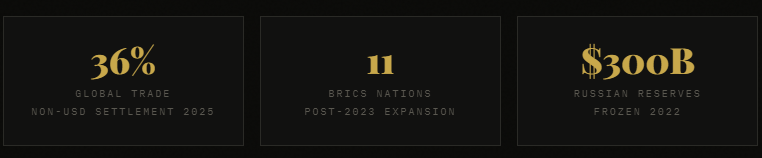
Every BRICS summit, every bilateral currency swap agreement, every announcement of yuan-denominated oil contracts now generates a ripple in crypto markets not because Bitcoin is immediately replacing the dollar in energy trade, but because each step chips away at the foundational assumption that underpins dollar dominance. Geopolitical tension between the West and the emerging multipolar bloc is, in this reading, structurally bullish for assets that exist outside the dollar system. The volatility this creates is real, but the directional signal it sends to long-term Bitcoin holders is clear.
Safe Haven or Risk Asset? The Identity Crisis at the Heart of Crypto
One of the most persistent sources of confusion and volatility in geopolitically-driven crypto markets is Bitcoin’s unresolved identity. Is it a safe-haven asset, like gold, that investors rush toward during crises? Or is it a high-risk speculative instrument that gets sold aggressively when fear spikes and liquidity is needed? The honest answer is that it has been both, depending on the nature of the crisis, the state of the market cycle, and the composition of the investor base at any given moment.
The “digital gold” narrative has genuine empirical support in some contexts. Bitcoin’s fixed supply of twenty-one million coins, its resistance to inflation, and its freedom from any single government’s control give it theoretical safe-haven properties. In countries experiencing hyperinflation or currency collapse, such as Argentina, Turkey, Nigeria, and Lebanon, there is robust evidence of Bitcoin adoption as a wealth preservation tool, often directly correlated with deteriorating economic conditions driven by geopolitical pressure or misgovernance.
Yet in developed-market trading contexts, Bitcoin has repeatedly behaved more like a leveraged Nasdaq position than like gold. During the March 2020 COVID crash, Bitcoin fell sixty per cent in two days, far worse than equities. During the 2022 Federal Reserve tightening cycle, which was itself partly a response to war-driven inflation, Bitcoin lost over seventy per cent of its value while gold held relatively steady. The correlation with risk assets during these episodes was near-perfect, driven by the behaviour of institutional investors who treat crypto as a high-beta allocation within broader risk portfolios.
The resolution of this identity crisis matters enormously for how geopolitical tension translates into crypto volatility going forward. As the investor base matures, shifting from retail-dominated to institutionally-dominated, the short-term safe-haven properties may strengthen, since institutional investors with longer time horizons and genuine macroeconomic frameworks are more likely to buy Bitcoin as a geopolitical hedge rather than sell it as a risk asset. The trajectory of this maturation, interrupted but not reversed by the crises of 2022, is one of the defining questions for the next decade of crypto market development.
Cyber Warfare, State-Sponsored Hacks & Crypto Infrastructure
Modern geopolitical conflict does not take place only on physical battlefields. The cyber domain has become an active theatre of great-power competition, and cryptocurrency infrastructure has emerged as both a target and a tool of state-sponsored cyber operations. The intersection of cyber warfare and crypto markets introduces a category of geopolitical risk that is unique to digital assets, one that can create sudden, severe volatility events with little traditional warning.
North Korea’s Lazarus Group has become the most extensively documented state-sponsored cryptocurrency theft operation in history. According to analyses by Chainalysis and various government intelligence assessments, North Korean hackers have stolen billions of dollars in cryptocurrency over the past decade, using it to fund the regime’s weapons programs in direct circumvention of international sanctions. Major hacks, including the $625 million Ronin Network breach in 2022 and the $100 million Harmony Horizon breach the same year, were attributed by U.S. authorities to Lazarus Group operatives.
Russia and Iran have also been active in using cryptocurrency to evade sanctions and fund influence operations. Russian intelligence services have reportedly used cryptocurrency to finance social media manipulation campaigns and to pay foreign operatives. Iran’s Revolutionary Guard Corps has used crypto mining, exploiting subsidised domestic electricity as a sanctions relief mechanism, effectively mining Bitcoin at near-zero energy cost and exchanging it for hard currency through informal channels.
The defensive dimension of this cyber conflict is equally significant. Western governments, working through agencies like OFAC, Europol, and national cybersecurity agencies, have developed increasingly sophisticated capabilities to trace, seize, and disrupt cryptocurrency flows associated with hostile state actors. High-profile seizures, including the recovery of $3.6 billion in Bitcoin linked to the 2016 Bitfinex hack, demonstrate both the traceability of blockchain assets and the growing capability of state actors to intervene in crypto markets in ways that have immediate price implications. Each such event sends a fresh signal about the regulatory environment, adding another layer of geopolitically driven volatility.
Security Alert
The geopolitical implications are significant: every major exchange hack, every DeFi protocol exploit attributed to state-sponsored actors, creates a sudden shock to crypto market confidence that goes beyond the dollar value stolen. It raises questions about the security of the entire infrastructure. It adds a risk premium that purely financial analysis cannot capture because the adversary is not a criminal seeking profit but a state seeking to fund military capability.
Central Bank Digital Currencies: The State Strikes Back
The geopolitical pressures described in this article have not simply buffeted cryptocurrency markets passively; they have triggered an active state response in the form of Central Bank Digital Currencies (CBDCs). Over 130 countries are now in various stages of CBDC research, development, or deployment, representing a concerted effort by governments worldwide to reclaim monetary sovereignty in the digital age and to build infrastructure that can compete with and potentially constrain the decentralised crypto ecosystem.
The geopolitical motivations behind CBDC development are complex and sometimes contradictory. China’s digital yuan (e-CNY) has been explicitly developed with the dual purpose of enhancing domestic monetary control and providing an alternative payment infrastructure that bypasses dollar-dominated systems. Its rollout has been carefully coordinated with China’s broader geopolitical strategy, including its Belt and Road Initiative and bilateral currency arrangements with trading partners. A digital yuan that becomes the settlement currency for Asian trade would represent a profound geopolitical shift, one that Western policymakers are acutely aware of.
The United States and European Union, meanwhile, have been more cautious about CBDC development, partly because of the very real threat they pose to the commercial banking system and partly because of political concerns about government surveillance of financial transactions. But the geopolitical competitive pressure from China’s e-CNY has increasingly forced a reassessment. A world in which China’s digital currency dominates global trade settlement while the West’s financial infrastructure remains analogue is not one Western governments are prepared to accept.

For Bitcoin and the broader crypto ecosystem, the CBDC race creates a complex competitive and regulatory dynamic. CBDCs may reduce demand for stablecoins, particularly dollar-pegged ones like USDT and USDC, by providing government-backed digital currency alternatives. Regulatory frameworks built around CBDC infrastructure may impose new constraints on private crypto activity.
But CBDCs also validate the core premise of digital money and may paradoxically accelerate the adoption of cryptocurrency as a censorship-resistant alternative for users who distrust government-issued digital currency. Each CBDC announcement, each geopolitical escalation of the digital currency race, moves cryptocurrency markets sometimes down, sometimes up, but always with the energy of a contest whose stakes extend far beyond financial returns.
Investor Strategy in a Geopolitically Charged Market
For investors navigating cryptocurrency markets in an era of persistent geopolitical tension, the analytical framework must be fundamentally different from the one that sufficed during the relatively calm decade of post-2008 globalisation. Geopolitical risk is no longer a tail event to be managed with a small hedge allocation; it is the baseline condition of the market, a permanent and accelerating feature of the investment environment that shapes volatility, correlation, and return profiles in ways that conventional crypto analysis misses.
The first principle for geopolitically-aware crypto investors is to distinguish between types of geopolitical shock and their different implications for different parts of the crypto market. An oil supply disruption affects Bitcoin mining economics directly but may benefit certain DeFi applications as petrodollar recycling flows seek alternative venues. A major government sanctions announcement may spike Bitcoin volatility sharply, but could simultaneously drive significant capital flows into privacy coins or decentralised exchanges. A CBDC launch in a major economy may threaten stablecoins but reinforce the narrative around censorship-resistant assets.
The second principle is time-horizon management. Geopolitically-driven volatility is disproportionately concentrated in short time horizons, the hours and days immediately following a shock. Investors with the financial resilience to hold through initial panic episodes have historically been rewarded, as the medium-term response to geopolitical tension has tended to reinforce crypto’s fundamental narratives rather than undermine them. Dollar-cost averaging, buying systematically through volatility rather than attempting to time entries, has proven particularly effective in geopolitically turbulent periods.
Third, portfolio construction must account for the specific correlations that geopolitical events create. Bitcoin’s correlation with equities rises sharply during liquidity crises driven by geopolitical shocks, making it a poor hedge precisely when investors most need one. Gold, despite its lower upside potential, maintains its safe-haven properties more reliably in the immediate aftermath of military conflicts. A thoughtful allocation that includes both Bitcoin and gold, capturing Bitcoin’s structural upside while maintaining gold’s crisis-period reliability, reflects the actual empirical behaviour of these assets in geopolitical stress scenarios more accurately than treating Bitcoin as a wholesale gold substitute.
Conclusion
The relationship between geopolitical tension and cryptocurrency volatility is not a temporary phenomenon that will resolve itself when the current conflicts end or when some future diplomatic settlement restores global stability. It is structural, embedded in the nature of what cryptocurrency is, what it does, and why it was created. Bitcoin was, after all, born in the immediate aftermath of the 2008 financial crisis itself a product of deep systemic failures in the architecture of globalized finance. Its very existence is a bet that the existing order is fragile, that state-controlled money is unreliable, and that decentralized, censorship-resistant alternatives will find their moment when that fragility is exposed.
Geopolitical tension is that exposure, repeating in a different register with every new conflict, every new sanction, every new currency collapse. War creates the conditions under which Bitcoin’s value proposition becomes legible to populations that would otherwise never have encountered it. Oil shocks stress the energy infrastructure on which mining depends while simultaneously driving inflation that erodes confidence in central bank money. Sanctions create demand for permissionless financial rails. De-dollarisation creates demand for neutral monetary assets. CBDCs create demand for privacy-preserving alternatives. Each pressure point in the geopolitical system finds a corresponding resonance in the cryptocurrency ecosystem.
For investors, for policymakers, and for the technologists building the next generation of financial infrastructure, the implication is the same: there is no separating the future of money from the future of power. The world’s great geopolitical contest between American unipolarity and a multipolar challenge, between open and closed financial systems, between state-controlled and decentralised monetary infrastructure, will be fought simultaneously in missile ranges, oil fields, diplomatic chambers, and blockchain networks. Bitcoin’s volatility is not a bug in this system. It is the sound of that contest, conducted at the speed of markets, every second of every day. Understanding it, truly understanding it, may be the most important financial literacy skill of the coming decade.